



Errors-in-Variables and Rainfall-Flow Modelling
Tuesday, 26 April 2011
The ‘Errors-in-Variables’ (EIV) problem related originally to linear regression model estimation when, in addition to noise on the measurement of the dependent variable, there is noise on the independent variables (regressors or regression variables). In a transfer function model estimation context, errors on the output variable measurement are handled by the RIVBJ and RIVCBJ estimation routines in CAPTAIN, but errors on the input variable(s) can cause asymptotic bias on the parameter estimates. There has been a great deal of research on this topic (see e.g. Soderstrom, 2007) but its importance in practical terms depends very much on the nature of the problem. Recent research has considered to what extent it might be a problem in DBM rainfall-flow modelling when the model is of the Hammerstein type, with the input ‘effective rainfall’ nonlinearity a function of the noisy flow measure-ment, acting as a surrogate measure of the catchment storage.


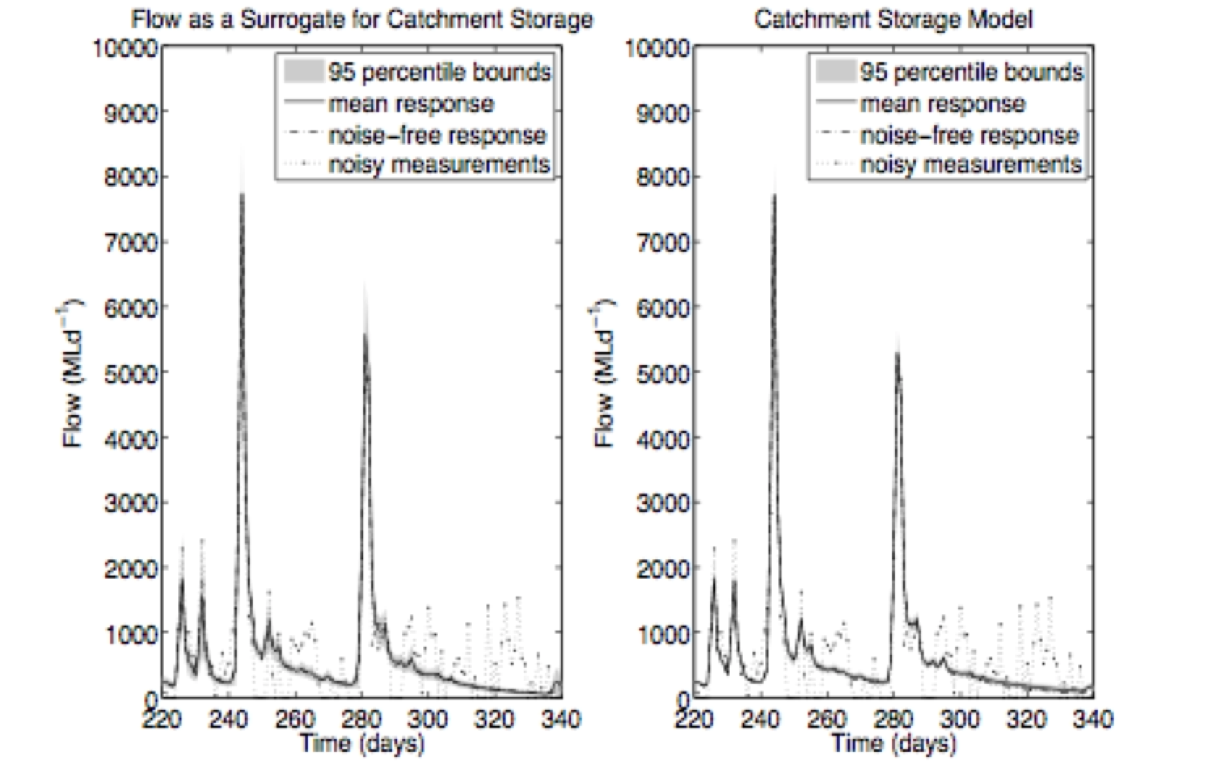


The figure shows the results of a Monte Carlo simulation study comparing the model performance (left panel) with that obtained with a DBM model where the catchment storage variable is obtained from from a catchment simulation model (see e.g. Young, 2003) and so is not subject to noise (right panel). It is clear that, despite the high noise level, the performance is very similar, so EIV does not seem to problematic in this case.
It is still not clear, however, to what extent noise on the input rainfall measurement causes significant EIV problems. The only work on this so far (Linden et al., 2009) suggests that it is not significant, with the EIV results (where EIV is allowed for in the estimation) being very similar to the EIV results.
J.G. Linden, P.C. Young, T.Larkowski, and K.J. Burnham. Identification of a catchment model via errors-in-variables approaches - a preliminary study. In Proc. 20th Int. Conf. on Systems Engineering, Coventry, UK, pages 312–320, 2009: click Linden_EIV_RF.pdf to see a copy of paper.
T.Söderström. Errors-in-variables methods in system identification. Automatica, 43:939–958, 2007.
P.C. Young. Top-down and data-based mechanistic modelling of rainfall-flow dynamics at the catchment scale. Hydrological Processes, 17:2195–2217, 2003.