



Large Simulation Model Emulation
Tuesday, 26 April 2011
In association with Marco Ratto and Andrea Pagano at the Joint Research Centre of the EEC at Ispra, Italy, we have been developing an approach to the ‘emulation’ a large computer simulation model by a low order DBM-type model. The idea here is either to enhance the DBM modelling procedure before real time series data are available or to build a bridge between a large simulation model based on a hypothetico-deductive strategy and a low order DBM model based on real data and inductive modelling principles (see Young and Ratto, 2009, 2011). There are two types of emulation model, both of which are ‘stand-alone’: i.e. once built, they can operate completely separately to the large simulation model. The first is a ‘nominal emulation’ model that emulates the large model for one set of the large model parameter values; the second is a ‘full emulation’ model that emulates the large model over a whole range of user-specified parameter values. In both cases, emulation is almost always very good, with the low order model closely reproducing over 99.9% of the high order model behaviour. However, synthesis of the the full emulation model requires much greater effort and the ‘mapping’ of the relationship between the large and small model parameter values. A typical map of this kind is shown in the Figure below.


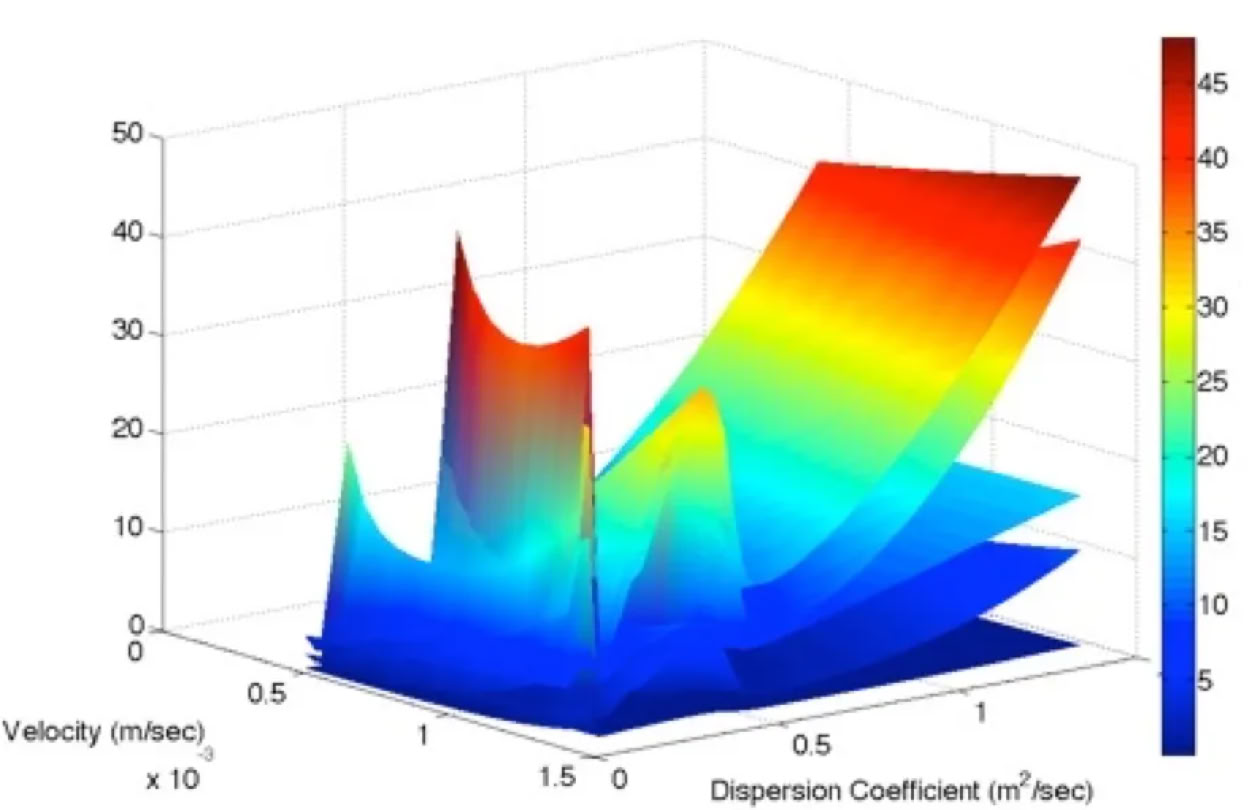

Parameter mapping for emulation of a large advection-dispersion simulation: Figure 12.7 from chapter 12 of Young, 2011.

P.
P. C. Young and M. Ratto. A unified approach to environmental systems modeling. Stochastic Environmental Research and Risk Assessment, 23:1037–1057, 2009.
P.C. Young Recursive Estimation and Time Series Analysis: an Introduction for the Student and Practitioner, Springer-Verlag, 2011.
P.C. Young and M.Ratto. Statistical emulation of large linear dynamic models. Technometrics, 53:29–43, 2011.