

Technical Matters


Closed-Loop RIV and RIVC Estimation
Friday, 29 April 2011
A new and particularly simple refined IV method for estimating discrete and continuous-time transfer function models enclosed within a feedback control system, such as that shown in the Figure, has been developed recently (Young, 2011).


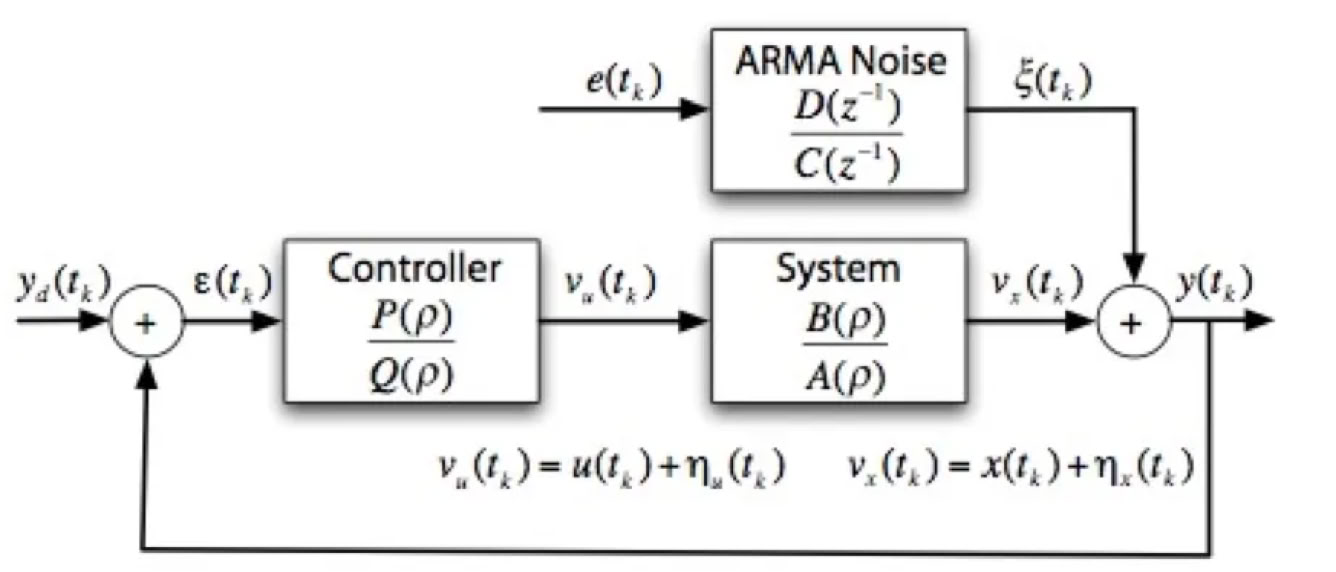


This ‘three-stage’ method derives from a simple two-stage algorithm (Young et al., 2009) that yields consistent, but statistically inefficient, parameter estimates. The additional third stage allows for statistically efficient estimation of the enclosed TF model parameters when the system within the closed-loop is stable. The attraction of this new approach is its relative simplicity: in particular, the resulting Closed-Loop RIV (CLRIV) and Closed-Loop RIV for Continuous-time models (CLRIVC) algorithms are straightforward to implement since they use the existing RIV and RIVC estimation algorithms described in previous chapters of this book and implemented by the rivbj and rivcbj routines in the CAPTAIN Toolbox. As a result, the coding of the algorithms in CAPTAIN is straightforward, requiring only three calls to these existing algorithms. However, it is hoped to develop more computationally efficient clriv and clrivc routines in the future. One advantage of the two-stage approach is that it appears to allow for the estimation of systems that are open-loop unstable (Young, 2011).
P. C. Young, H.Garnier, and M.Gilson. A simple refined IV method of closed-loop system identification. In Proceedings 15th IFAC Symposium on System Identification SYSID09, St. Malo, France, 2009.
P. C. Young Recursive Estimation and Time Series Analysis: an Introduction for the Student and Practitioner, Springer-Verlag, 2011.